
|
|
#1
 02-02-2008, 04:56 PM
|
||||
|
||||
 Another mystery bass?
New to the forum - hi everybody!
I was interested to see the English "mystery bass", because it shows some similarities to my own gamba form double bass. Mine has a Thomas Dodd label inside, which I was sure was a fake at the time I bought it, because I thought the bass was only about 100 years old. But then a luthier who did a few repairs on the bass for me, a guy with an excellent reputation around here, told me that only the neck is that "new", whereas the body is at least 200 years old based on the workmanship he could see inside, maybe even older. He also told me that the bass bar is unusually close to the center line, so it was presumably built as a three-string and converted to a four-string with a new neck about 100 years ago. He didn't want to commit himself about the authenticity of the label, but he said it didn't feel like an English bass to him, more like Bohemia/Austria - but he said that was just a gut feeling, whereas he was 100% sure about the age. Obviously this has got me wondering whether the label could be genuine after all. Ken's "mystery bass" description mentions that gamba form basses were being made in England at that time. Does anybody know if Thomas Dodd's workshop made any? Is Thomas Dodd one of the luthiers that a label faker would target? And can I read anything into the fact that the label is located above the level of the f-hole, making it quite hard to see - wouldn't a forger put his fake label in a more prominent place? I've attached a picture of the label, happy to take some pictures of the bass and post them if anyone's interested. Thanks in advance for any opinions! Last edited by Ken Smith; 02-03-2008 at 12:32 PM. Reason: Posts moved with all related replies from "Name That Bass" and new Thread started here. 
|
|
#2
02-02-2008, 05:50 PM
|
|||
|
|||
|
That doesn't look like a 200 year old label to my eye. I'd be skeptical.
|
|
#3
02-02-2008, 07:22 PM
|
||||
|
||||
|
Quote:
|
|
#4
02-03-2008, 12:16 AM
|
||||
|
||||
 Dodd/Label..
Quote:
On your Gamba Bass, PLEASE post some pictures of it here. I would love to look at it. On Dodd making a Gamba Bass or rather the workers in his shop, I have heard of at least one but haven't seen it myself. B.Fendt Snr. and J.Lott Snr. were the main Bass makers for Dodd starting in 1798/9 till at least 1810. Dodd by the way is a very Famous name and copying his label is not that hard to do as they have been pictured in books. A new trend has been happening with labels from lesser know makers than Strad or Guarnieriin hopes they might 'pass muster'. Actually, they usually don't at first and eventually never do. Most people see a Violin cornered Bass and think the highest order of it pedigree wise as compared to the Gamba models with the same attribution. I was just thinking about this corner style thing this week while playing my Cornerless Bass. My thought was, "why does a Bass of even a Violin need anything more than Gamba corners or corners at all other than for the sake of looks and style"? The Violin corner Pluses are mainly looks and style to me. Also, it can show off the Purfling work of the maker as well as his rib Bending ability for what ever that's worth. The Minuses are, hitting the corners with the Bow, breaking them off or them stabbing you in the leg. The Gamba corner Pluses are smaller targets for your Bow to hit and maybe easier to make. The Corner bend is less work as are the making of the corner blocks. The Minuses are less fancy look than the Violin model and that's about it. Value might play here a bit as I think Violin models usually sell for more on both old Pedigree Basses as well as modern hand made or even factory Basses of any age. Sound? Some think the Violin model is tighter and the Gamba model looser and the Cornerless model even more loose. The fact is that unless you start with ONE Bass and keep chopping it down to the other shapes, we cannot judge the sound if it's not the exact same Bass. Arnold? Your thoughts please on this. I know you have some experience based opinions. Share them if you will.
__________________
Ken Smith ~ http://www.kensmithbasses.com http://www.kensmithbasses.com/doublebasses/ http://www.facebook.com/KenSmithBasses https://www.instagram.com/kensmithbasses/ https://www.facebook.com/ken.smith.904750 
|
|
#5
02-03-2008, 03:28 AM
|
||||
|
||||
|
Quote:
If you guys want to see any close-ups of details, just tell me what you want to see and I'm happy to oblige. Although since my label seems to be a fake, that means I still don't know where my bass comes from, so I guess it's not going to throw any light on Ken's mystery bass after all... 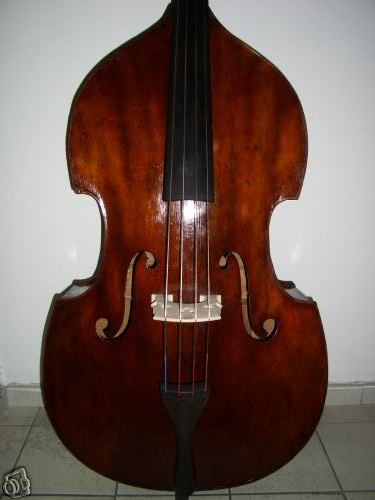 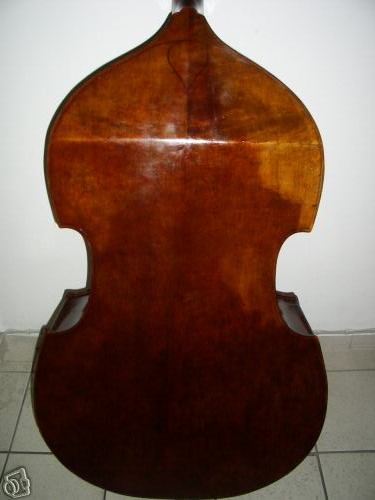 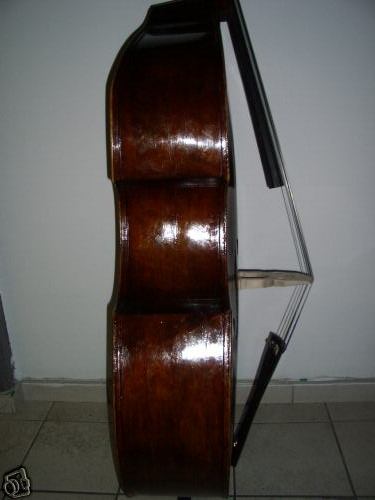 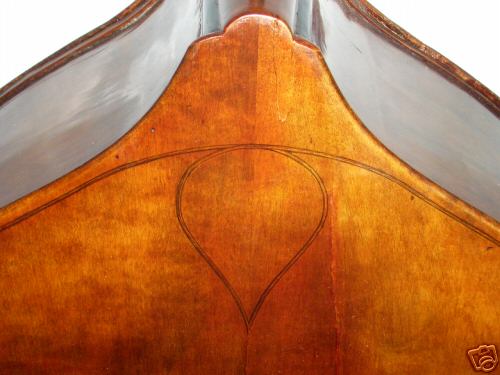 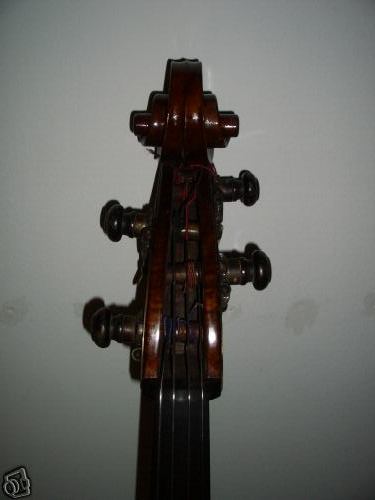 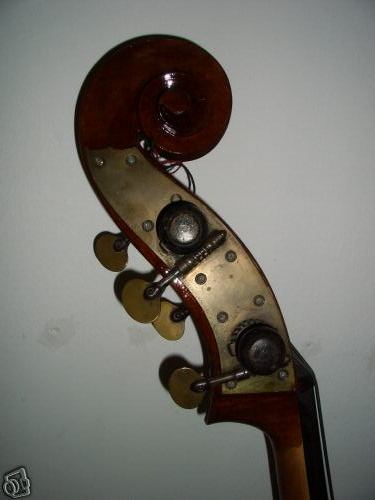
|
|
#6
02-03-2008, 08:07 AM
|
||||
|
||||
|
Quote:
One other aspect you didn't mention is carrying the bass - violin corners make better carrying handles than gamba corners. Your cornerless bass is very cool, but I can't even imagine how I'd pick it up.
|
|
#7
02-03-2008, 09:44 AM
|
||||
|
||||
 on your bass..
The Bass looks Bohemian/German to me about 100 years old or so +/- 25 yrs.
The Varnish looks new as I don't' see much wear/patina on the body. The Back looks lighter in color and the grain, looks like plywood. Maybe some better pictures with better light might help.
__________________
Ken Smith ~ http://www.kensmithbasses.com http://www.kensmithbasses.com/doublebasses/ http://www.facebook.com/KenSmithBasses https://www.instagram.com/kensmithbasses/ https://www.facebook.com/ken.smith.904750
|
|
#8
02-03-2008, 09:59 AM
|
|||
|
|||
|
Quote:
When I designed my "Ergonomic Contrabass" I initially wanted to build an amorphous, asymmetrical, cornerless blob of a bass. I felt I could best derive both tone and good ergonomics from that shape. But I ended up adding upper corners because cornerless basses are near-impossible to move around, and that goes against the ergonomic nature of my design. I did not want players to strain themselves or accidentally drop and destroy my work (and their livelihood). I make the upper corner blocks very unobtrusive on the inside to keep the smooth, rounded interior contours. I also am aware of how cornerless basses tend toward long rib cracks because there are no corner blocks to stop cracks from opening up like a zipper. In the long bouts of mine I applied the ancient technique of adding cross-grain linen strips to act as crack-stoppers. So far so good.
|
|
#9
02-03-2008, 10:14 AM
|
||||
|
||||
|
Humm.. on the shapes..
Well, I played my Cornerless last night and moving it around is not easy. I can lift from the end of the Fingerboard thru the Strings and balance it on the center Rib curve but that's about it or pick it up by the Neck. Sound wise, it's the best that I have ever owned and equally amongst the best to anything I have ever played.
On the long free vibrating Ribs, when I tap mine they sound very deep and louder than normal. They do not have that higher pitched wood sound like when tapping a cornered Bass. It sounds as if the Ribs are more of a part of the sound of the Bass like the Top and Back is. They also vibrate quite a bit as well. On my Bass, the burled Maple Ribs seem quite thin like veneer and are completely doubled with opposite grain Spruce on the inside. This may be part of the sound as well. The Ribs being about half Maple and half Spruce in thickness. I don't think the Spruce doubling is original but I also don't know what the Ribs were like originally either. Perhaps when Jeff opens the Bass we can learn a little more about its past.
__________________
Ken Smith ~ http://www.kensmithbasses.com http://www.kensmithbasses.com/doublebasses/ http://www.facebook.com/KenSmithBasses https://www.instagram.com/kensmithbasses/ https://www.facebook.com/ken.smith.904750
|
|
#10
02-03-2008, 02:01 PM
|
||||
|
||||
|
Quote:
Yes, those picture taken by the previous owner are pretty poor and may well be misleading. The true color of the upper back is much darker than in the close-up of the purfling, but not as dark as in the overall back picture. The lighter areas at the top right and near the right hand C bout are finish differences, no sign of wood having been replaced. They're also not as light as the picture shows. All I know about this bass's history is what the previous owner told me: sometime in the mid 90s he (an amateur violinist) went to a double bass teacher friend to ask for classical lessons for his son, who was about 14 at the time, and he asked the same friend for help buying an instrument. The friend called back a few weeks later to say he'd found an instrument at a low price because of very poor condition, and he felt it would turn out pretty good when it was restored. The customer agreed, and the music teacher had the restoration done by a luthier friend of his in the Frankfurt region, identity unknown. The customer never knew what work was done, he trusted his music teacher friend and just gave him the cash for the purchase and restoration, and the music teacher took care of everything. Some ten years later I bought the bass because the son had finally plucked up the courage to admit to his fearsome dad that he had no interest in music! The bass clearly hadn't been well cared for in the last 10 years: the strings were dire and poorly fitted, the bridge was much too wide and not shaped to the top at all (I could almost slide a credit card under it), the sound post was too long and installed in the wrong place, which had led to a crack opening at the f-hole. But my teacher and I agreed that even in that condition it sounded great, a beautifully dark old wood tone and wonderfully open especially on the A and D strings, and all other cracks very professionally repaired. So I bought it, on the basis that I was getting an approx. 100 year old, great sounding no-name German bass for everyday amateur jazz use, with a joke fake label inside. I paid 2400 bucks plus 350 total for the repair work, new bridge and new strings, and I still think I got a terrific bargain - and Charlie Haden said "wow" when he heard it (honest, no kidding!). As I already said: the information from the luthier that it was a 200-year old 3-string body with a 100-year old 4-string neck grafted on made me wonder if the label could be real after all. Now that I related the story, I realize that this is highly unlikely - if the music teacher and his luthier pal had thought the label was real, they wouldn't have sold the bass to a 14-year old kid beginner. I'll try to post some better pictures here in the next few days. Thanks to everybody for your interest!
|
|
#11
02-03-2008, 02:07 PM
|
||||
|
||||
|
further opinions..
Yes, a read Dodd would me be cheap to anyone including a 14yr old.
Still many German basses like this sound great for jazz or orchestra. I played beside 3 of them last night and all week long in the section. I used an Italian bass.  On the 3-string theory, I don't buy it. Most Germanic Basses and almost all Bohemian Basses were made a 4-strings. The 3-string was in wider use in England, France, Spain, Italy and USA. Germany and eastward were mostly 4-string by then with some 5s as well.
__________________
Ken Smith ~ http://www.kensmithbasses.com http://www.kensmithbasses.com/doublebasses/ http://www.facebook.com/KenSmithBasses https://www.instagram.com/kensmithbasses/ https://www.facebook.com/ken.smith.904750
|
|
#12
02-03-2008, 03:39 PM
|
||||
|
||||
|
Quote:
 Alternative hypothesis is that mine is indeed German and therefore not a 3-string. But then you need to explain the limited space available for the four strings, i.e. the closeness of the bass bar to the center line. The luthier found that even his narrowest bridge for 3/4 bass was too wide, he had to use one intended for a 1/2 bass, measuring only 3 3/4 inches between feet centers. He thought nobody would build a 4-string bass that narrow, but it would be normal for a 3-string. That sounded logical to me, what do you think? BTW, I don't think the back is plywood. When I look at my modern hybrid, I can clearly see the plywood layers running parallel at the edge of the back, whereas at the edge of the carved top I see perpendicular grain. On the old bass we're discussing here, I see perpendicular grain at the edges of the top and the back. Am I right in assuming that's a reliable way to distinguish solid from plywood?
|
|
#13
02-04-2008, 12:14 AM
|
||||
|
||||
|
well..
On my Bass, the FFs are extremely wide apart. If the Bass bar was against the upper F hole eye, the bridge width needed would be about 180-190mm wide. That's not a 3/4 or 4/4. That's a 5/4 or 6/4 if such a thing exists. Actually, the current Bar is set in a biot and the Bridge width will be about 165mm. On your Bass, where the Bar is set means little to the origin of the Bass unless it's a rare instance whereas it's the original bar. Highly unlikely I think.
The style of your Bass looks totally German to me. I have seen 3-string German Basses but these were lower grade factory Basses around 100 years old or so, maybe more. I believe they were made for the export market as German did ship across Europe into France and England where the 3-string ruled up until the 20th century. On the wood of your Back, I would like to see the edges and some other shots in better lighting. I can't tell what kind of wood it is from your shots. On the other hand, many English Basses actually look German as that is what the copied the most. It would also be good to post ALL of its measurements like the ones I give on my webpages. Here is an example; Upper Bout: 22"Belly Length: 47" (45"- 46" after Block cut) Center Bout: 15 3/8" Bottom Bout: 28 1/2" String Length: about 42" w/Block Cut (was 44") Rib Depth: 8 1/2" ** Upper Bout tapers from 8 1/2" to 5 3/4" with slope of the Back to the Neck Block.
__________________
Ken Smith ~ http://www.kensmithbasses.com http://www.kensmithbasses.com/doublebasses/ http://www.facebook.com/KenSmithBasses https://www.instagram.com/kensmithbasses/ https://www.facebook.com/ken.smith.904750
|
|
#14
02-04-2008, 04:39 AM
|
||||
|
||||
|
Quote:
Quote:
Quote:
Tomorrow I'll try to take some pictures under natural daylight at our patio door, and I'll make sure the colors look right at least on my computer before posting.Quote:
|
|
#15
02-04-2008, 05:56 AM
|
|||
|
|||
|
That cornerless bass looks like a real beauty Ken, where did you find it? Was it expensive? What kind of gigs do you use it for?
|
|
#16
02-04-2008, 10:12 AM
|
||||
|
||||
|
the Cornerless..
Quote:
The sound is so powerful and deep, it almost hurts your ears when listening to it. You ask about its usage? Well, it will do anything you ask it to do. I played two Jazz gigs already with it. One was a Vibes/Bass duo with no amp and the other was a Piano/Bass duo where I used an old Mic. in the bridge in the amp. Sound wise, it filled the room and with regular Flexocors it has a ton of sustain. With the Bow, it's about the easiest Bass to Bow that I own. In an Orchestra, I am never drowned out by anyone or the entire section for that matter. The price since you ask is in my opinion not high for what it does and what it is. Basses lately, the real good ones have been selling from about 140-470k from what I have seen with the old Italians with the English going for 120-150 for the best ones. This Bass was offered to me by the owner before he died for 160k. Within a few months of his passing, the Bass was evaluated by some of New Yorks finest which helped me acquire it for a lower price. It is going into restoration soon but last year, just after I got it several qualified buyers called to ask the price for the Bass as-is pre-restored. The price quoted was then 100k and for 2 months was played and used by the Principal and asst. Prin. of the National Symphony. One comment was that a 'Horn player on break came back and said 'I can hear that thing from the bathroom'. The Bass is not for sale as-is any more. After its restoration I will play it and break it back in. Then, if I decide to sell it I will set the price to reflect the market for a similar sounding Bass considering its restored condition, age and pedigree. I don't think it will be less than what my house cost!
__________________
Ken Smith ~ http://www.kensmithbasses.com http://www.kensmithbasses.com/doublebasses/ http://www.facebook.com/KenSmithBasses https://www.instagram.com/kensmithbasses/ https://www.facebook.com/ken.smith.904750
|
|
#17
02-04-2008, 06:08 PM
|
||||
|
||||
|
sorry for being offtopic, but....:
"David Moss Join Date: 02-02-2008 Location: Ettlingen, Germany Posts: 6" ETTLINGEN, what is going on there?  http://www.youtube.com/watch?v=5povNXsb8eI
|
|
#18
02-06-2008, 03:12 AM
|
||||
|
||||
|
Quote:
But seriously - thanks for the heads up, I didn't know that was on YouTube. The soloist Matteo Gaspari is impressive, isn't he? I saw him on stage here once, playing the music in a production of Suesskind's play "The Contrabass". Not a local guy as far as I understand, I believe he came here from Italy to study classical double bass at the nearby Karlsruhe music school, graduated in 2006 with flying colours, and by then had so many engagements with local orchestras and ensembles that he decided to stay on. Ettlingen's gain, I think!
|
|
#19
02-06-2008, 05:12 AM
|
||||
|
||||
|
Quote:
Upper Bout: 20" Belly Length: 43" Center Bout: 14 1/8" Bottom Bout: 25 1/2" Scale Length: 42 1/2" Rib Depth: 8" Angle break in back plate: begins 9" from top of back plate, upper rib bout tapers to 5 1/2" at the neck block 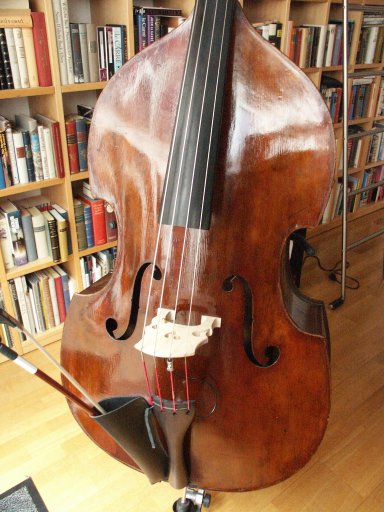 Overview of the top plate. At least you can now see it's made of wood, in contrast to the previous picture! The color looks about right on my monitor. Full size image (1920x2560) is here. 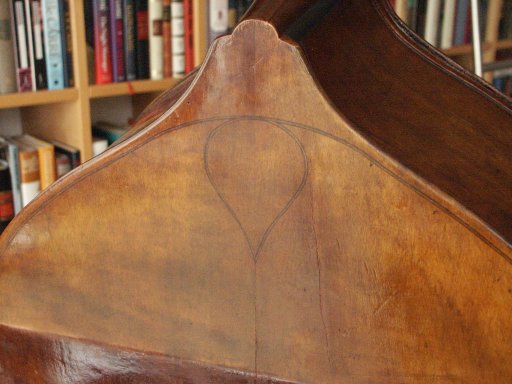 Upper back plate. The apparent sudden change in color/finish from the lower left corner isn't real, it's just the different angle of illumination above and below the angle break. Purfling seems not to be just painted, I can feel an indentation when I run my thumbnail over it. Full size image (2560 x 1920) here. 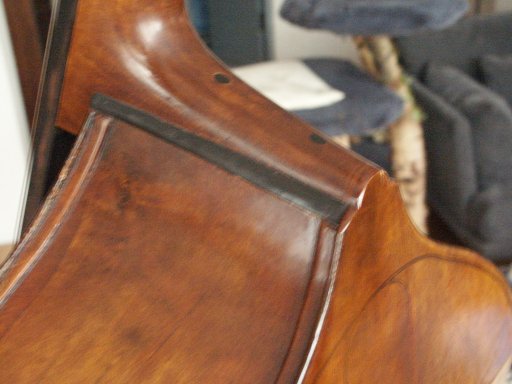 Sorry for the camera shake on this one, 1/4 sec handheld exposure...  Color here is slightly lighter than in reality, the next picture catches it better. Another seeker of knowledge on the TB forum has the same ebony strips either side of the neck heel and small circular patch, see here - are these covering a peg or bolt? My luthier told me it's an approx. 100 year old neck on an even older body, but didn't say whether the neck graft was done 100 years ago or recently. I know the bass had a major restoration in the mid 1990's, maybe it was done then. Full size image (2560 x 1920) here. Color here is slightly lighter than in reality, the next picture catches it better. Another seeker of knowledge on the TB forum has the same ebony strips either side of the neck heel and small circular patch, see here - are these covering a peg or bolt? My luthier told me it's an approx. 100 year old neck on an even older body, but didn't say whether the neck graft was done 100 years ago or recently. I know the bass had a major restoration in the mid 1990's, maybe it was done then. Full size image (2560 x 1920) here. 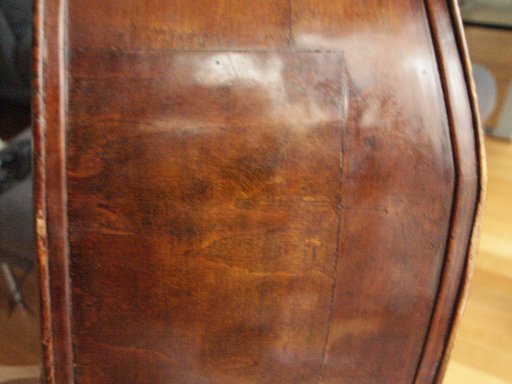 Upper bout ribs on G side, showing a large patch of non-matching wood. Colors here look OK to me. My luthier told me this is a very old repair, he found the workmanship pretty good but the choice of wood eccentric to say the least. I stupidly forgot to ask him what wood was used in the patch, but my bass teacher thinks it's poplar. Full size image (2560 x 1920) here.
|
|
#20
02-06-2008, 08:12 AM
|
||||
|
||||
|
your Bass...
First off, on the Rib measurements, were they inside the Top and Back or including them?
On the wood of your Back and Ribs, again it looks like Slab or rolled cut Maple like you find in Veneer or Plywood. Maybe even Birch but the closeups are blurry and I can't see the grain clearly. Please, look with a flashlight and magnifier glass along the edges of the Bass and Rib-to-Rib joints and tell me if you see any hint of laminations there. I just can't see it well enough in these pictures. On the origin, looking at the angle break side view with the outer rib linings it looks Germanic/Bohemian but even more so now than before. The Varnish also looks fairly new so I would guess it was re-finished not long ago. The wood on the Back and Ribs are very unusual for a Bass from this region. The purfled design in the lower Back is similar (but not identical) to Basses made by Pfretzschner or rather Markneukirchen shop Basses.
__________________
Ken Smith ~ http://www.kensmithbasses.com http://www.kensmithbasses.com/doublebasses/ http://www.facebook.com/KenSmithBasses https://www.instagram.com/kensmithbasses/ https://www.facebook.com/ken.smith.904750
|
 |
| Currently Active Users Viewing This Thread: 2 (0 members and 2 guests) | |
| Thread Tools | |
| Display Modes | |
|
|


 Linear Mode

