
|
|
#1
 12-18-2008, 11:24 AM
|
||||
|
||||
 Origin or the outer Rib Linings/Moldings..
I am starting this thread to explore the origin or the outer Rib Linings or Moldings as sometimes referred to.
Usually we equate this to just German School work (German/Czech border work as well) but I have seen Italian and English and American Basses with outer Linings as well. I have never seen a 'real' French Bass with Linings other than a few Basses from Hawkes that are referred to as French as well as a few others that I think were miss-attributed for value purposes. I would argue each and every one of them though as they all looked Germanic to me! In the Germans we see it as far back as the mid 19th century if not earlier with Neuner and Hornsteiner. These were two family names that go back centuries in Mittenwald. Some of them worked individually and some as the N&H firm. Now all the Basses seen by them have these outer moldings. In the 20th century we see just about every 'Shop' Bass and imported brand label with Linings from Morelli, Pfretschner, Juzek, Hoffner etc with the outer Linings as if that is THE way to make a Bass. I wonder why none of the current hand-builders we know do this here in USA. Pollmann still does it but only in the German models. All of the Italian models are lining-free from the outside. As far back as the late 18th century English makers have used Moldings on the Ribs as well. We have seen this with Hill, Lott/Dodd, Fendt, Furber and to some degree with Forster using square Molded Corners but not exclusively to Forster on the Corners. The earliest Italian Bass I have seen with Linings/Moldings is one by Beretta, a Guadagnini school maker, c1770-'90. These are narrow width Linings under 1/2" wide. I have a Martini from 1919 (earliest seen example of his work) with wide flat outer linings about 3/4" width. I have seen mostly wide-flat Moldings on the English Basses but a few of the narrow form. I have seen a late (c.1908) Neuner-Horn. with wide-flat strips as well. In talking about Bass Schools we must group the English with the rest of the British Isles as well. With the German School, add bordering Austrian and Bohemian makers. I don't think the 'inland' Bohemians, Moravians or Austrian/Viennese makers used outer Linings on the Basses and this goes for Hungary and Romania. These Schools besides being somewhat loyal to Stainer also copied the great Italian works as far as the Violin thru Cellos go. The Basses though kept the Viol/Gamba from for the most part. Here are some examples of various Lining/Molding styles from Basses that I have or have passed thru me. Please feel free to Post your own 'Lining' pics for discussion and comparison as well. Here are a few Germans, 19th, and 20st Century;     Here's an old Kay that we are so familiar with;  And here's my Martini with wide flat outer Linings/Moldings that have been used by the English as well as a an occasional Italian; 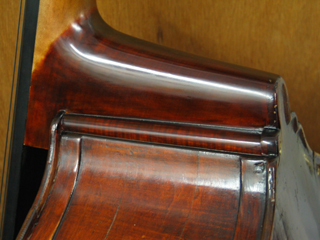 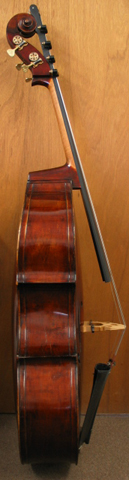   So, show your outer Lining/Molding Pics if you got em.. By the way, besides extra gluing surface area for the Top and Back plates, what other advantages do you see these Linings may have? Stiffening up the Ribs? Will that cause the Top to crack more when the Back shrinks each Winter? Does it help the Tone of the Bass? Does it make the Bass deeper or brighter sounding or is it mostly just decoration? Luthiers? Please share your insights and experience here.. 
__________________
Ken Smith ~ http://www.kensmithbasses.com http://www.kensmithbasses.com/doublebasses/ http://www.facebook.com/KenSmithBasses https://www.instagram.com/kensmithbasses/ https://www.facebook.com/ken.smith.904750 

|
|
#2
12-18-2008, 12:52 PM
|
|||
|
|||

Funny you should post this today, as I just looked at this bass and thought its outer linings and plate tuning gears inconsistent with the French attribution.
http://www.uptonbass.com/mid-ninetee...-upright-bass/ What do you think?
|
|
#3
12-18-2008, 01:24 PM
|
||||
|
||||
 French?
Quote:
The Gears are German for one but possibly not original. The age is less that advertised in my opinion and the Origin is German as well. If French, then who made it? What Shop? I think this is closer to 1900 or slightly after. That roundback is Germanic in its arching as well. I have seen a few of this style Bass marketed as French before which I think is incorrect. Don't get me wrong here on the quality. They are nicely made. Just not in France or in the mid 19th century. About 5 years ago after joining an Orchestra I turn around to look at the Bass behind me and asked "is that a French Bass?".. The Reply; "no, it's German." .. It looks a bit similar to the one you referenced but did not have the outer Linings at all. It actually had a German label from 1903. I would have guessed 1860-1880 by its looks and French origin as well. Early 20th century makers like Alfred Meyer made French looking sloped shouldered Basses but in Germany. The molding strip across the Neck area is typical German and seen in Mittenwald Basses as well as from some shops further north. Ok, back on topic..
__________________
Ken Smith ~ http://www.kensmithbasses.com http://www.kensmithbasses.com/doublebasses/ http://www.facebook.com/KenSmithBasses https://www.instagram.com/kensmithbasses/ https://www.facebook.com/ken.smith.904750
|
|
#4
12-18-2008, 03:39 PM
|
|||
|
|||
|
I had enough trouble doing the inside linings!
For the inexperienced luthier (me), outside linings could spell trouble. Lots of potential for possible mistakes; open seams, unevenness, poor fit, etc, etc. It makes you appreciate the skill level in the old basses.
|
|
#5
12-18-2008, 09:33 PM
|
|||
|
|||

No matter who started it, it's a bad idea.
|
|
#6
12-18-2008, 11:53 PM
|
||||
|
||||
 ok..
ok..
Quote:
__________________
Ken Smith ~ http://www.kensmithbasses.com http://www.kensmithbasses.com/doublebasses/ http://www.facebook.com/KenSmithBasses https://www.instagram.com/kensmithbasses/ https://www.facebook.com/ken.smith.904750
|
|
#7
12-19-2008, 09:42 AM
|
|||
|
|||
|
1) Glue joint too wide; prevents seams opening, therefore more cracks.
2) Glue joint too wide, prevents de-coupling of the vibrating plates, therefore less sound. 3) Interior dimension is less (if the outside linings were not there, the corpus could be subsequently larger within the same plate size), therefore less depth of tone. 4) Looks wrong (no other member of the violin family has them). 5) When they come loose, buzzes occur. But I think they are a good thing to have on psychobilly players' basses...
|
|
#8
12-19-2008, 11:10 AM
|
||||
|
||||
|
Hummm..
Quote:
#1 makes sense. #2 is understandable as this stiffens up the Bass. #3 to me is the most obvious but most often not recognized. The same outer lip dimensions of the Top exposed with the Linings in place mean the Ribs themselves are that much further into the Plates therby reducing the internal air space of the 'sound-box'. #4 is not a complete answer as no other member of the current family of 4 (excluding the Viols) has the Gamba Form in use or the angled Back bend we see on so many Basses. The Bass is the only one of the 4 that does not actually have a standard shape or design like the Violin, Viola or Cello has and has had for over 400 years. So, why not the Linings which may have been introduced to slow down 'twist' of the wider Rib depth used on Basses. It is true that many of the old Italian Basses including Maggini and d'Salo have Rib depths approaching 9" but were made without the outer Moldings. So, in this case, what is the oldest Bass you (anyone reading this) have seen with these outer moldings/Linings on the Ribs? #5 is something I have never seen but then again, I am 'not' the person calls when they might come loose. I just haven't seen this happen, ever! So, 2 questions remaining in my mind here; 1) What is the oldest example known of outer Linings/Molding on Bass Ribs.. and 2) What do you think the reasoning was behind this idea originally. Arnold, tell them about the construction of the Ribs on my Cornerless Bass. Talk about something different entirely and the sound is something that's hard to come close to.
__________________
Ken Smith ~ http://www.kensmithbasses.com http://www.kensmithbasses.com/doublebasses/ http://www.facebook.com/KenSmithBasses https://www.instagram.com/kensmithbasses/ https://www.facebook.com/ken.smith.904750
|
|
#9
12-19-2008, 01:19 PM
|
|||
|
|||
|
Quote:
Maker #2 "Vaht?" Maker #1 "Vee add linings on zee outside, too. Zen zee seams vill stay closed no mattah vaht!" Maker #2 "You vill be known forever as genius!" 
|
|
#10
12-19-2008, 01:26 PM
|
|||
|
|||
|
Can you use the lack of moldings as a clue to the age of a bass?
|
|
#11
12-19-2008, 01:26 PM
|
||||
|
||||
|
lol..
Quote:

__________________
Ken Smith ~ http://www.kensmithbasses.com http://www.kensmithbasses.com/doublebasses/ http://www.facebook.com/KenSmithBasses https://www.instagram.com/kensmithbasses/ https://www.facebook.com/ken.smith.904750
|
|
#12
12-19-2008, 01:30 PM
|
|||
|
|||
|
Quote:
|
|
#13
12-19-2008, 06:45 PM
|
|||
|
|||
|
Quote:
|
|
#14
12-19-2008, 07:24 PM
|
|||
|
|||
|
I'll second that
Quote:
I'd be suspicious of the origin of any 'Italian' bass with outside linings. (edit). But then I'm automatically suspicious of any bass called Italian.
|
|
#15
12-19-2008, 07:42 PM
|
||||
|
||||
|
Nope..
Quote:
Basses from 400 years ago didn't have them and Chinese Basses made tomorrow don't either. I don't think Moldings account for much when dating a Bass. I have seen one old German Bass where the Moldings looked to be added after the Bass was made. The Germans I believe are the ones that have used outer Moldings most uniformly for the past 120 years or so. Prior to that, the usage of Moldings in Germanic Basses or lack of Moldings were kind of mixed as were the methods of making from Shops, to Factories to Individuals. If it's a German 'thing' by nature as far as inception goes then maybe it was robust durability that they were after. One thing that can be said about German engineering overall is; 'they build them strong'. Basses, Doors, Tanks.. you get the picture.. Strong doesn't always equate to 'good' especially where sound is concerned.
__________________
Ken Smith ~ http://www.kensmithbasses.com http://www.kensmithbasses.com/doublebasses/ http://www.facebook.com/KenSmithBasses https://www.instagram.com/kensmithbasses/ https://www.facebook.com/ken.smith.904750
|
|
#16
12-19-2008, 07:53 PM
|
||||
|
||||
 Removing them?
Quote:
Quote:
Here is one example where it could help. I saw an old German Bass one day where the Top and Back were either flush with the Ribs in places (no lip showing) or less than flush from shrinkage. If the Moldings were removed here, it would save some work shortening the Ribs at the Blocks or widening the Pates at the center joint which is also another remedy but way more costly. Still, touch-up would be a big job. The sound might be improved as well which would easily off-set any value argument in my opinion from the alteration if it was an improvement. My Martini shown above has wide flat outer Moldings and when it was last opened for some repairs I believe Arnold did trim the inside Linings a bit. That Bass sounds better every time I play it. I saw one French Bass where the inner Linings were 2x as thick and 2x as wide as needed, maybe more. That is at least 4x the mass. They were reduced I believe when the Bass was restored and some improvement was noticed. Will all the other work performed, it's hard to say exactly what did what.
__________________
Ken Smith ~ http://www.kensmithbasses.com http://www.kensmithbasses.com/doublebasses/ http://www.facebook.com/KenSmithBasses https://www.instagram.com/kensmithbasses/ https://www.facebook.com/ken.smith.904750
|
|
#17
12-19-2008, 08:17 PM
|
||||
|
||||
|
well..
Quote:
Again, if this is a German trait, then let me say this. There are many German Basses that are build with German features like Dovetail Neck joints for instance beside the Molding issue. Two of my Basses have their original Neck Blocks, the Martini and the Candi. In both cases it was discovered that when the Back or Top was taken off (Top of the Martini and Back of the Candi) for repairs it was realized that they had 'hidden' Dovetail joints. The Top and Back plates covering the Joint, and very neatly as well. On your second point, you are smart to be suspicious with the Italian naming. It is done 100 fold on the Violins so it's just trickled down to the Basses. I have seen what could be Shop Basses made in either Germany or France (I have seen 2 of each) where the Bass either looks 100% like an old German Shop Bass or a French Mirecourt Bass (Jacquet/Claudot style) but have Italian Labels. I have played one of each and they didn't sound typical Italian to me so I think my guess was correct. On both cases, the Bass did look like it had extra care given on the wood and/or varnish so it's not out of the question that the shop bought the Bass from wherever and completed and Labeled it as well. On the other hand, we see so many wannabes coming out of Romania and Hungry these days with Italian styling Labeled or not. I once asked a very fine Bass player (who is no longer with us) about the way to tell if a Bass was Italian or not, this being asked when I first got my Old Italian Bass back in 1973 before actually making the deal to buy it. His answer was "when you play it, you can see the Pasta coming out of the F-Holes".. There was so much Pasta coming from that Bass, I needed not one or two but several 'dogie bags'..Well, if that's the case, then who needs to get appraisals anymore?.. lol.. I have had several fine sounding non-Italian Basses that could pass for the 'Pasta School' if one was blind folded while listening or being fed. Still, there are the 'Value' differences we must be aware of as far as good playing/sounding Basses vs. investment grade Basses which usually have the sound as well.
__________________
Ken Smith ~ http://www.kensmithbasses.com http://www.kensmithbasses.com/doublebasses/ http://www.facebook.com/KenSmithBasses https://www.instagram.com/kensmithbasses/ https://www.facebook.com/ken.smith.904750
|
|
#18
12-21-2008, 02:40 PM
|
|||
|
|||
|
Italian
There are "Italian" violin family instruments from the 19th and 20th centuries that originated in Germany, and today there are a fair number of "Italian" violins that originally came from China.
Not all Italian instruments have the "Italian" sound. Much of Italian workmanship is not very good. The work that came out of Italy between 1550 and 1750 bares almost no resemblance to 19th and 20th century work. 19th and 20th century American made violin family instruments have been and probably still are being sold to Europe where they get relabled as Italian. Nearly any skilled workman can imitate the work of another worker from another country. If it looks like pasta and tastes like pasta, it's probably pasta (but maybe not). Just some observations.
|
|
#19
12-21-2008, 04:26 PM
|
||||
|
||||
|
lol..
Quote:
Martin, is there really a place called Italy? Just checking.. I have owned many Italian Basses. Only about half of them were properly labeled or labeled at all. These were all 20th century Basses. In 100-200 years from now someone will put my Martini label in a Juzek/Wilfer and sell it as Italian. Mark my words.. I have had almost as many come thru here labeled or claiming to be Italian that were not so I have personally experienced it both ways.Martin, you are welcome to come over and inspect my Basses.
__________________
Ken Smith ~ http://www.kensmithbasses.com http://www.kensmithbasses.com/doublebasses/ http://www.facebook.com/KenSmithBasses https://www.instagram.com/kensmithbasses/ https://www.facebook.com/ken.smith.904750
|
|
#20
01-13-2009, 07:43 AM
|
||||
|
||||
|
Arnold, have you ever come across with a bass with ONLY outside linings? I would have thought that his scenario would maintain the thinner glue surface, increase the vibrating plate thickness and protect the overhang slightly. So why is this not common?
I have a Meinel bass where the outside lining is basically a thin 1/4 round molding right up to the edge of the overhang. For a student bass, this really protects the edge well. Looks pretty crap though. I think I'll remove it when I restore the bass.
|
 |
| Currently Active Users Viewing This Thread: 2 (0 members and 2 guests) | |
|
|


 Linear Mode

